
Peptides Everywhere: Why They Matter, and Why They’re Hard to Use Well
Peptides are central to modern biology and medicine—but understanding what they can and cannot do requires seeing them as signals embedded in complex, adaptive systems.
Why Peptides Now Occupy a Central Role in Biology
Peptides have moved from relative obscurity to prominence with surprising speed. They now appear in discussions of metabolism, aging, repair, cognition, and immune regulation, often framed as precision tools capable of nudging biology in targeted ways. It is easy to read this visibility as novelty. In reality, the underlying science is not new. What has changed is the way modern biology understands itself—less as a collection of organs and systems, and more as a web of signals through which cells communicate, coordinate, and adapt.
Over the past several decades, advances in molecular biology have made it possible to identify receptors, map intracellular pathways, and observe how small molecular signals propagate through complex networks. In that context, peptides are especially appealing. They are short chains of amino acids—simple in structure compared with large proteins—yet capable of conveying highly specific biological instructions. Many are endogenous, already part of human physiology, which adds to their intuitive appeal as interventions that appear “natural” or inherently compatible with the body.
At the same time, peptide synthesis and modification have become far more accessible. What once required specialized laboratories can now be produced at scale, altered to improve stability, or packaged in ways that extend biological activity. Alongside this technical change has come a broader cultural turn toward biological optimization. As interest has grown in longevity, metabolic health, and performance, attention has gravitated toward interventions that promise specificity rather than blunt force. Peptides fit this narrative well, offering the promise of targeted influence rather than systemic disruption.
That promise, however, can be misleading. Visibility should not be mistaken for validation. The same features that make peptides attractive—their potency, specificity, and integration into signaling systems—also make them difficult to understand and easy to oversimplify. In biology, small signals can have wide effects, and those effects often depend on timing, context, and system state in ways that are not immediately obvious. What looks precise in theory may behave unpredictably in practice.
This article begins from that tension. Peptides are neither miracle tools nor empty hype. They occupy a middle ground where genuine biological insight coexists with significant uncertainty. Understanding why peptides have become so visible is therefore not an academic exercise. It is the first step toward understanding why clarity—rather than enthusiasm—is required to evaluate them.
What Peptides Actually Are (Beyond the Buzzword)
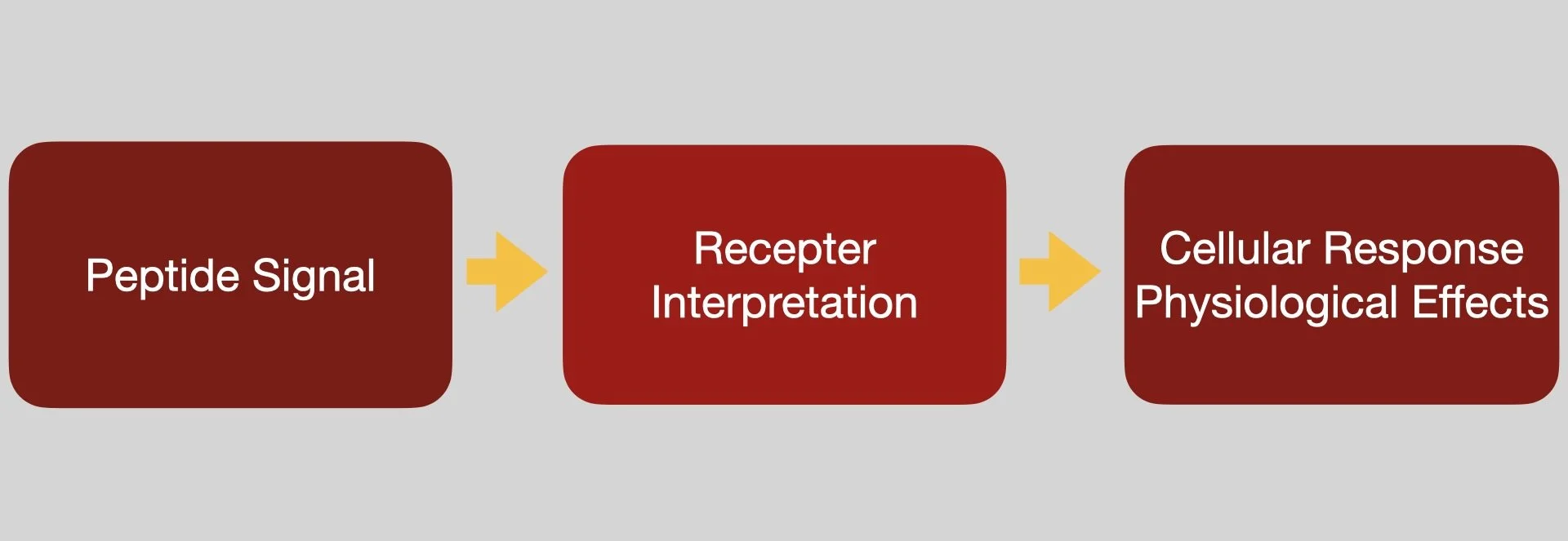
Peptides don’t act on the body by themselves. Their effects depend on how cells receive and interpret the signal, and how that signal is integrated across the body.
Peptides are often portrayed as if they were substances with discrete effects—something that can be “taken” to produce a particular outcome. That framing is intuitive. Biologically, however, it is misleading. Peptides are best understood as signals, not agents. They convey information within living systems rather than acting independently upon them.
At a basic level, peptides are short chains of amino acids, smaller than proteins but larger than individual amino acids or small molecules. Many function as hormones, neurotransmitters, or paracrine signals, binding to specific receptors on cell surfaces or within cells. That binding event does not produce an outcome on its own; it initiates a cascade. Intracellular pathways are activated or suppressed, gene expression may shift, metabolic processes adjust, and feedback mechanisms respond.
Crucially, the same peptide can behave differently depending on where and when it is encountered. Receptor density varies by tissue; downstream signaling pathways differ between cell types; age, inflammation, metabolic state, and prior signaling history influence how a signal is interpreted. In this sense, peptides do not “do one thing.” They participate in processes already underway—processes occurring within systems that adapt rather than respond linearly.
This context dependence is not a flaw; it is how biology maintains flexibility. But it complicates attempts to use peptides predictably. A signal that appears beneficial when brief or localized may become counterproductive if stimulation is prolonged or misplaced. Biological systems compensate, recalibrate, and resist sustained perturbation. Peptides operate within that adaptive space.
Another common misconception is that peptides are inherently gentle or safe because many are endogenous. Endogenous does not mean simple, and it does not mean harmless. The body tightly regulates peptide production, degradation, and receptor exposure for a reason. Introducing a signal outside its native timing or concentration can alter feedback loops that evolved to maintain balance.
Understanding peptides therefore requires abandoning the idea of single-cause, single-effect interventions. This is not a semantic distinction; it changes how peptide claims should be interpreted. Peptides are not supplements in the conventional sense, nor are they functionally interchangeable. They are informational molecules whose effects emerge from interaction with complex systems. Appreciating that distinction is essential before evaluating which peptide claims are plausible, which are premature, and which misunderstand biology altogether.
Where Peptide Science Is Clinically Established—and Why That Matters
Amid widespread claims about peptides, it is important to recognize that some peptide-based therapies are not speculative at all. They are clinically validated, widely prescribed, and supported by extensive human data. This does not suggest that all peptide ideas are sound. It does, however, demonstrate that peptide biology can translate into effective medicine when the underlying physiology is well understood and the path from signal to outcome is navigated with rigor.
GLP-1–based therapies provide the clearest modern example. Glucagon-like peptide-1 is an endogenous hormone involved in glucose regulation, appetite signaling, and energy balance. Its biology was explored for decades before therapeutic success was achieved. Native GLP-1 itself was never a practical drug candidate; it is rapidly degraded in the body and acts within tightly regulated temporal windows. What ultimately proved effective were modified analogs designed to extend activity, improve receptor engagement, and allow controlled delivery.
The clinical success of agents such as Ozempic, Wegovy, and Victoza rests on several conditions that are often overlooked in broader peptide narratives. The target receptor was well characterized, with a clear understanding of its distribution and downstream effects. The signaling pathway was studied in humans across multiple physiological states, rather than inferred solely from animal models. And the compounds were engineered to behave predictably rather than mimic native signaling perfectly. Success came not from preserving biological purity, but from imposing constraint.
Just as important, the limitations of GLP-1–based therapies are well documented. Their effects vary between people. Adverse effects are real. Long-term outcomes continue to be studied and debated. None of this diminishes their value. Instead, it illustrates a central lesson of peptide translation: even when a peptide therapy works, it does so within defined boundaries, and with tradeoffs that must be understood and managed.
Other clinically established peptide therapies reinforce the same lesson. Insulin and its analogs, among the earliest peptide-based medicines, remain indispensable yet demand precise dosing and constant vigilance. Parathyroid hormone analogs used in bone disease demonstrate that the pattern of exposure—intermittent versus continuous—can reverse biological effects entirely. Vasopressin and somatostatin analogs further illustrate that peptide therapies may succeed through selective constraint or suppression of signaling rather than simple enhancement, and that narrow therapeutic windows are common rather than exceptional.
These examples reveal why clinically successful peptides are the exception, not the rule. They succeeded because biology was deeply understood, signaling pathways were constrained rather than amplified indiscriminately, and translation was treated as a long, iterative process. Their existence should increase confidence in peptide science as a field, while simultaneously raising the bar for claims made on its behalf. The success of GLP-1–based therapies does not validate all peptide claims; it demonstrates how demanding the path from biological signal to reliable therapy actually is.
Where Peptide Science Is Promising—but Still Incomplete
Beyond clinically established therapies lies a wide terrain of peptide research that is neither speculative fantasy nor settled medicine. This is the domain that fuels much of the current interest in peptides: areas where biological rationale is strong, early findings are intriguing, and translation remains uncertain. Navigating this middle ground requires holding two ideas at once. The science deserves to be taken seriously, and seriousness does not imply readiness.
One area of active investigation involves peptides associated with tissue repair and regeneration. Many tissues rely on short-lived signaling peptides to coordinate inflammation, cellular migration, angiogenesis, and remodeling after injury. In experimental settings, adjusting these signals can alter healing dynamics, sometimes dramatically. The appeal is easy to understand. If repair is orchestrated by signals, perhaps signals can be tuned. What remains unresolved is how these effects scale in humans, where repair unfolds amid aging tissue, variable immune responses, and competing physiological priorities. Enhancing one phase of repair may inadvertently disrupt another.
Immune-modulating peptides represent another promising but complex area. The immune system is heavily peptide-driven, relying on signaling fragments to activate, suppress, or redirect responses. Small shifts in signaling balance can move outcomes from tolerance to inflammation, or from protection to pathology. Experimental peptides have shown the capacity to influence immune behavior, but immune systems are deeply contextual and adaptive. Effects observed under controlled conditions may dissipate, invert, or provoke unintended consequences in living humans whose immune histories are anything but uniform.
Metabolic and mitochondrial signaling peptides are also under investigation, particularly in the context of cellular stress responses and energy regulation. Cells use peptide signals to sense nutrient availability, oxidative stress, and energetic demand, adjusting metabolism accordingly. Modulating these signals has produced compelling mechanistic data, especially in animal models. What remains unclear is whether nudging these pathways produces sustained benefit—or whether it simply provokes compensatory responses that restore baseline function by other means.
Across these domains, a recurring pattern emerges. The biology is coherent. The mechanisms make sense. Early data often look encouraging. Yet coherence is not completion. These peptide systems evolved to operate transiently, locally, and in coordination with many other signals. Isolating one element risks misunderstanding the role it plays within the larger system. The challenge is not separating promise from hype, but separating mechanistic plausibility from demonstrated, repeatable human outcomes. That process takes time—and a willingness to accept that some elegant biological ideas may resist practical translation.
Why Translating Peptide Biology into Human Outcomes Is So Difficult
The distance between a promising biological signal and a reliable human outcome is where most peptide narratives break down. This process—often referred to as translation, or more simply reliable human application—is not a formality or a regulatory hurdle. It is the point at which biological complexity asserts itself. Peptides, precisely because they are potent signals embedded in adaptive systems, are unusually difficult to translate.
One challenge is stability. Many peptides are rapidly degraded by enzymes in blood and tissues, sometimes within minutes. Native signaling molecules are designed to appear briefly, act locally, and disappear. Extending their presence—whether through chemical modification or delivery strategies—changes not only duration, but biological effect. A signal intended to be transient can become persistent, altering downstream responses, feedback loops, and receptor sensitivity.
Delivery introduces another layer of difficulty. Reaching the intended tissue does not guarantee engaging the intended receptor in the intended way. Peptide distribution varies across organs, and small differences in concentration can produce qualitatively different effects. A peptide that appears selective in vitro may interact with multiple receptors in vivo, particularly when introduced at concentrations that exceed physiological norms. This receptor promiscuity is not an anomaly; it reflects signaling systems that evolved for flexibility rather than precision under artificial conditions.
Context dependence further complicates translation. Biological systems do not respond to signals in isolation. Age, metabolic state, inflammation, hormonal background, and prior signaling history all modulate how a peptide is interpreted. An effect observed in young or metabolically uniform animal models may not appear—or may even reverse—in older, heterogeneous human populations. Even within the same person, responses can shift over time as systems adapt.
Feedback and compensation are often underestimated. Signaling pathways rarely operate in straight lines. When a pathway is stimulated repeatedly, counter-regulatory mechanisms tend to emerge. Receptors down-regulate, alternative pathways activate, and the system seeks a new equilibrium. Short-term effects may look promising precisely because long-term adaptation has not yet occurred. This is where elegant biology most often meets resistance.
Finally, animal-to-human extrapolation remains a persistent limitation. Many peptide effects are first observed in rodents, where signaling pathways, receptor distributions, and lifespans differ meaningfully from those of humans. These models are invaluable for exploring mechanism, but they are poor predictors of durability, safety, and net effect in complex human physiology.
These challenges explain why peptide development is littered with plausible ideas that never mature. Failure at the translation stage does not imply that the biology was misguided. It reflects the reality that peptides operate at points of leverage within systems designed to resist simple manipulation. Small signals can produce large effects, but they can just as easily destabilize balance when removed from their native context. Understanding these constraints allows peptide research to be evaluated more realistically—appreciated for its promise, but approached with the caution demanded by systems that adapt, compensate, and remember.
The Gap Between Research and Marketing
The distance between peptide research and public-facing claims is not accidental. It arises from structural features of how modern biomedical knowledge is generated, communicated, and consumed. Peptides sit at an especially vulnerable point in this process because their biology is real, their mechanisms are often intelligible, and their effects can be demonstrated convincingly in narrow experimental settings. Because peptide biology looks plausible and works in narrow settings, claims are often made that extend beyond what the evidence supports.
In controlled research environments, peptide studies are typically designed to probe specific effects under tightly constrained conditions. A peptide may activate a receptor, alter gene expression, or shift a cellular behavior in a particular cell type, dose range, or time window. These findings are valuable, but they are intentionally limited. They describe what can happen under defined conditions, not what reliably occurs across real human physiology. As results move beyond the laboratory, those conditions are often lost, and what remains is a simplified narrative divorced from the constraints that made the findings meaningful.
Public-facing narratives often begin where scientific caution ends. Mechanistic plausibility is treated as functional equivalence, and language shifts subtly but decisively—from “is involved in” to “supports,” from “modulates” to “improves.” Because many peptides are endogenous or resemble natural signaling molecules, they are frequently framed as working “with” the body rather than acting upon it. The implication is reassuring. It is also incomplete. This framing obscures the distinction between signals used transiently by a system and signals introduced persistently from outside it.
The pace of information flow widens the gap further. Research advances incrementally, often revising or contradicting earlier assumptions, while public discourse rewards clarity and confidence. Once a peptide acquires a reputation—whether as restorative, protective, or enhancing—that reputation can persist long after the underlying evidence has shifted or stalled. Retractions and null findings travel poorly. Enthusiasm travels well.
Importantly, the existence of this gap does not imply deception in every case. Many claims emerge from sincere extrapolation rather than deliberate distortion. But extrapolation without context can mislead even when intentions are good. Recognizing this gap allows readers to ask better questions—not whether a peptide “works,” but where a claim sits along the path from mechanism to outcome, and whether its effects are likely to be durable, bounded, and predictable in real human physiology.
Implications for Research, Translation, and Clinical Use
The future of peptide research is less about discovering ever more signals and more about learning how to work with biological signaling intelligently. The field is moving away from the assumption that isolated peptides can be used broadly across the body, and toward a more disciplined understanding of when, where, and how these messages function within complex systems. Progress is likely to depend as much on refining how such signals are understood and applied as on identifying new ones.
One direction is improved targeting. Advances in delivery technologies aim to confine peptide activity to specific tissues or cellular environments, reducing off-target effects and limiting systemic disruption. This shift reflects a growing recognition that many peptide failures stem not from the signal, but from its inability to remain local and transient in a living organism.
Another shift emphasizes combinations and temporal sequence rather than isolated effects. Biological processes such as repair, adaptation, and metabolic regulation unfold in stages, coordinated by changing patterns of biological signaling. Research increasingly examines how multiple pathways interact over time, rather than asking whether a single peptide can carry the burden alone. This approach aligns more closely with how physiology actually operates. It also raises the bar for experimental design and interpretation.
Computational tools are beginning to influence peptide development as well. Improved modeling of receptor interactions, downstream pathways, and system-level responses may help identify candidates more likely to behave predictably before they ever reach animal or human testing. These tools do not eliminate uncertainty. They narrow it.
Perhaps most importantly, the field is slowly absorbing a harder lesson: biological elegance does not guarantee practical utility. Some peptide systems may prove too context-dependent, too adaptive, or too tightly regulated to be safely or reliably manipulated. Accepting this is not a failure of imagination. It is a mark of maturity. Disciplined science advances not only by discovering what can be done, but by recognizing what resists intervention.
For readers encountering peptide claims today, this perspective offers a steadier way to think about them. Peptides are neither a fleeting trend nor a universal solution. They are tools emerging from a deeper understanding of biological communication—tools that demand precision, patience, and restraint. As research continues, clarity is unlikely to come from louder claims. It will come from better questions, and from a willingness to acknowledge the complexity of peptide biology rather than simplifying it away.
Selected References
The following sources provide context for readers interested in the biological and translational foundations discussed above.
Alberts, B., Heald, R., Johnson, A., Morgan, D., Raff, M., Roberts, K., & Walter, P. (2022). Molecular biology of the cell(7th ed.). W. W. Norton & Company.
Begley, C. G., & Ellis, L. M. (2012). Drug development: Raise standards for preclinical cancer research. Nature, 483(7391), 531–533. https://doi.org/10.1038/483531a
Drucker, D. J. (2018). Mechanisms of action and therapeutic application of glucagon-like peptide-1. Cell Metabolism, 27(4), 740–756. https://doi.org/10.1016/j.cmet.2018.03.001
Fosgerau, K., & Hoffmann, T. (2015). Peptide therapeutics: Current status and future directions. Drug Discovery Today, 20(1), 122–128. https://doi.org/10.1016/j.drudis.2014.10.003
Freedman, L. P., Cockburn, I. M., & Simcoe, T. S. (2015). The economics of reproducibility in preclinical research. PLOS Biology, 13(6), e1002165. https://doi.org/10.1371/journal.pbio.1002165
Gadelha, M. R., Wildemberg, L. E., & Kasuki, L. (2022). The future of somatostatin receptor ligands in acromegaly. The Journal of Clinical Endocrinology & Metabolism, 107(2), 297–308. https://doi.org/10.1210/clinem/dgab726
Ioannidis, J. P. A. (2005). Why most published research findings are false. PLOS Medicine, 2(8), e124. https://doi.org/10.1371/journal.pmed.0020124
Liu, D., Testro, A., Majumdar, A., & Sinclair, M. (2025). The current applications and future directions of terlipressin. Hepatology Communications, 9(4), e0685. https://doi.org/10.1097/HC9.0000000000000685
Silva, B. C., & Bilezikian, J. P. (2015). Parathyroid hormone: Anabolic and catabolic actions on the skeleton. Current Opinion in Pharmacology, 22, 41–50. https://doi.org/10.1016/j.coph.2015.03.005
Wang, L., Wang, N., Zhang, W., Cheng, X., Yan, Z., Shao, G., Wang, X., Wang, R., & Fu, C. (2022). Therapeutic peptides: Current applications and future directions. Signal Transduction and Targeted Therapy, 7(1), 48. https://doi.org/10.1038/s41392-022-00904-4